
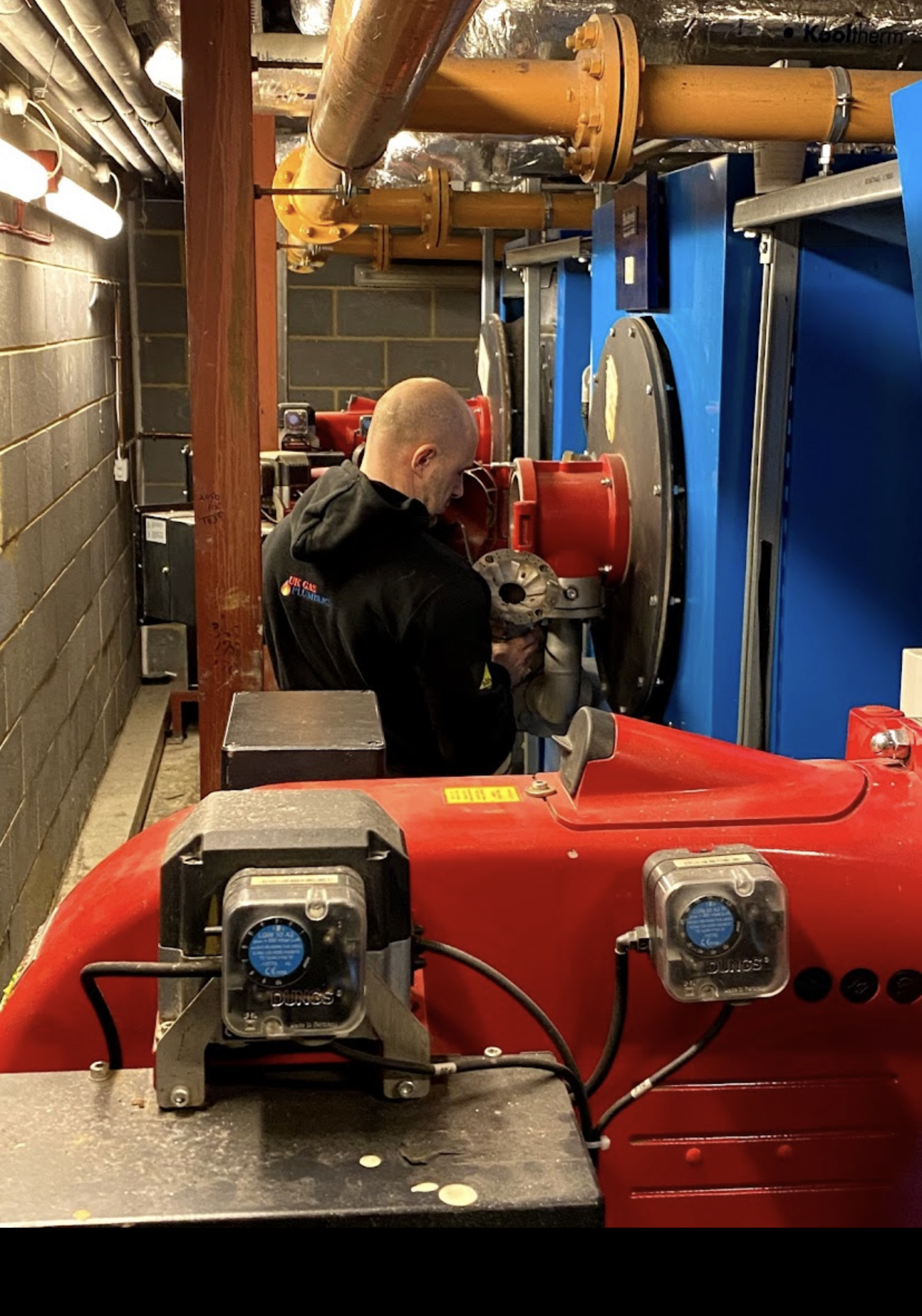
What a Roberts Gordon service includes
Roberts Gordon equipment is designed to run reliably for many years, but only when it is serviced at the intervals the manufacturer sets out. Below is what our engineers check on each type of Roberts Gordon appliance. The exact scope depends on the model and its installation, and the engineer will tell you before starting if anything on site needs to be looked at separately.
Roberts Gordon equipment is found in a wide range of commercial buildings, and installations vary a great deal — from a single appliance to large multi-unit set-ups with their own controls, flues and gas supplies. Because of that, our engineers look at the whole installation, not just the appliance in front of them: the gas supply, ventilation, flue, controls and electrical supply all affect how well Roberts Gordon kit performs and how long it lasts.
Roberts Gordon warm-air heater servicing
Warehouses, workshops and retail units rely on Roberts Gordon warm-air heaters to keep large volumes of air comfortable. Servicing covers the burner, heat exchanger, fan and motor, fan and limit thermostats, filters and flue. The heat exchanger is inspected closely for cracks or corrosion, because a failed exchanger can let combustion products into the space being heated.
Belt-driven and direct-drive fans are checked for wear and balance, filters are cleaned or replaced, and the overheat limit is proven to trip. Combustion is then analysed and the flue spillage tested so the heater can be left running safely for the season.
- Heat exchanger crack and corrosion inspection
- Fan, motor, bearings and drive belt checks
- Limit and fan thermostat proving
- Filter cleaning or replacement and flue spillage test
Roberts Gordon radiant tube and plaque heater servicing
Radiant tube and luminous plaque heaters are usually mounted high above the floor, so servicing is planned around access equipment and site safety. On a Roberts Gordon radiant system the engineer checks the burner head, ignition and flame rectification, the vacuum or pressure switch, the exhaust fan and the emitter tubes and reflectors.
Reflectors gather dust quickly, which reduces the heat that reaches the working area, so they are cleaned as part of the visit. Tube joints and couplers are checked for gaps, and where heaters share a common flue the induced-draught fan and its proving switch are tested together.
- Burner, ignition and flame proving checks
- Vacuum or pressure switch and exhaust fan tests
- Tube, coupler and reflector inspection and cleaning
- Suspension fixings and clearance to combustibles
Why regular Roberts Gordon servicing matters
The first reason is safety. Gas appliances that are not burning correctly can produce carbon monoxide, which has no colour or smell. Annual servicing with combustion analysis is the most reliable way to catch a problem before anyone is harmed. Under the Gas Safety (Installation and Use) Regulations 1998, anyone responsible for gas appliances at a workplace or in let property has a duty to keep them maintained in a safe condition.
The second reason is cost. A Roberts Gordon appliance that has drifted out of adjustment burns more gas for the same output. Dirty heat exchangers, blocked burners and badly set controls all quietly add to energy bills. A service resets combustion and controls so the equipment runs as efficiently as it was designed to.
The third reason is reliability. Most breakdowns announce themselves in advance — a weak ignition spark, a sticky valve, a fan bearing starting to whine, a condensate trap half full of sludge. A trained engineer spots these signs during a service and can replace a worn part during planned downtime instead of in the middle of a cold snap or a busy lunch service.
Finally, servicing protects warranties and insurance. Most manufacturers, Roberts Gordon included, require evidence of annual servicing by a competent engineer to honour extended warranties, and insurers increasingly ask for maintenance records after a claim.
How often should Roberts Gordon equipment be serviced?
As a rule, every commercial gas appliance should be serviced at least once every 12 months. Heating plant in heavy use, such as boilers serving large buildings or heaters running long hours in warehouses, often benefits from a six-monthly visit, with a full service before winter and a lighter inspection in spring. Your engineer can recommend a schedule based on how hard the equipment works, its age and its service history.
If you manage several sites or a large estate, the visits can be grouped into a planned preventative maintenance (PPM) schedule so that every Roberts Gordon appliance comes due at a sensible time of year and nothing is missed.
Who we carry out Roberts Gordon servicing for
Our customers range from single-site businesses to managing agents responsible for dozens of buildings. On the heating side, that includes office blocks, schools and colleges, churches and community halls, care homes, hotels, leisure centres, warehouses, factories and residential blocks with a shared plant room. Each type of site has its own pressures, and the engineer plans the visit around them.
Facilities managers often need Roberts Gordon servicing to fit into a wider maintenance programme, with job numbers, purchase orders and reporting in a consistent format. Landlords need records they can hand to tenants and insurers. Business owners mostly want the equipment working with as little disruption as possible. We handle all three, and you can approve quotes, message the engineer and download paperwork from one account.
Single sites and small businesses
If you run one site, you probably do not have a maintenance team. We keep things simple: one clear quote, a confirmed visit time, and a plain-English report afterwards explaining what was done to your Roberts Gordon equipment and whether anything needs attention.
Multi-site estates and facilities managers
For portfolios, Roberts Gordon servicing can be scheduled across sites with consistent reporting, so you can see the status of every appliance at a glance. Business customers can apply to pay on invoice against a purchase order.
What to have ready before the engineer arrives
A little preparation makes the visit quicker and keeps costs down. Before the engineer arrives, please:
Information to share when booking
The more the engineer knows in advance, the more likely the job is finished in one visit.
- The Roberts Gordon model name and serial number from the data badge
- How many appliances there are and where they are located
- Any fault codes, warning lights or unusual behaviour
- Previous service records or certificates, if available
- Site access times, parking, permits and any induction requirements
Access on the day
Please make sure the engineer can reach the Roberts Gordon equipment, the gas meter or emergency control valve and the electrical isolators. Plant rooms should be unlocked and clear of stored items, and roof or high-level access arranged in advance where heaters are mounted overhead. If there is an asbestos register for the building, have it available.
How we work
Every engineer we send is vetted before they join: Gas Safe registration and commercial competencies are checked, insurance is verified and their work is reviewed by customers after each job. You can see the engineer's reviews and compliance status before you accept their quote.
Prices are agreed before work starts, and payments are held securely until the job is complete. If anything goes wrong, our support team is there to help resolve it. This is how we make sure your Roberts Gordon equipment is looked after properly, every time.
Gas safety, compliance and paperwork
All gas work on Roberts Gordon equipment is carried out by engineers on the Gas Safe Register with the commercial competencies required for the appliance — for example commercial heating (COCN1, CODNCO1, CIGA1 or ICAEW-type categories as appropriate). You can check any engineer's registration on the Gas Safe Register before they start work.
After each visit you receive a written record of what was checked, the readings taken and any defects found. For heating plant, the service record and any non-domestic gas safety record can be added to your building logbook. These documents help you show your insurer, landlord, environmental health officer or auditor that the equipment is being maintained properly.
Areas we cover for Roberts Gordon servicing
We arrange engineers across Greater London and the towns around the M25, including Surrey, Kent, Hertfordshire, Essex, Berkshire, Buckinghamshire and Sussex. Commercial sites in central London, business parks, industrial estates, schools, hotels, restaurants and residential blocks with communal plant are all covered.
If your site is just outside these areas, get in touch anyway — we will tell you straight away whether we can help.
Book your Roberts Gordon service
Booking is simple. Use the online form to describe the Roberts Gordon equipment, its location and the work needed, or call 0208 935 5572. You will receive a clear quote before any work is booked, and you can manage the job, messages and paperwork from your account.
We are an independent service provider. We are not affiliated with or endorsed by Roberts Gordon; the brand name is used only to describe the equipment we work on. Our engineers use manufacturer data and genuine or equivalent-quality parts.
Roberts Gordon service FAQs
Also see
Roberts Gordon repairs · Roberts Gordon installation · All brands we work on